A Simple Memory Game — A Fun Project to Learn Frontend Logic
Rakshith
Writer & Explorer
⭐ A Simple Memory Game — How a Small Idea Became a Fun Learning Project
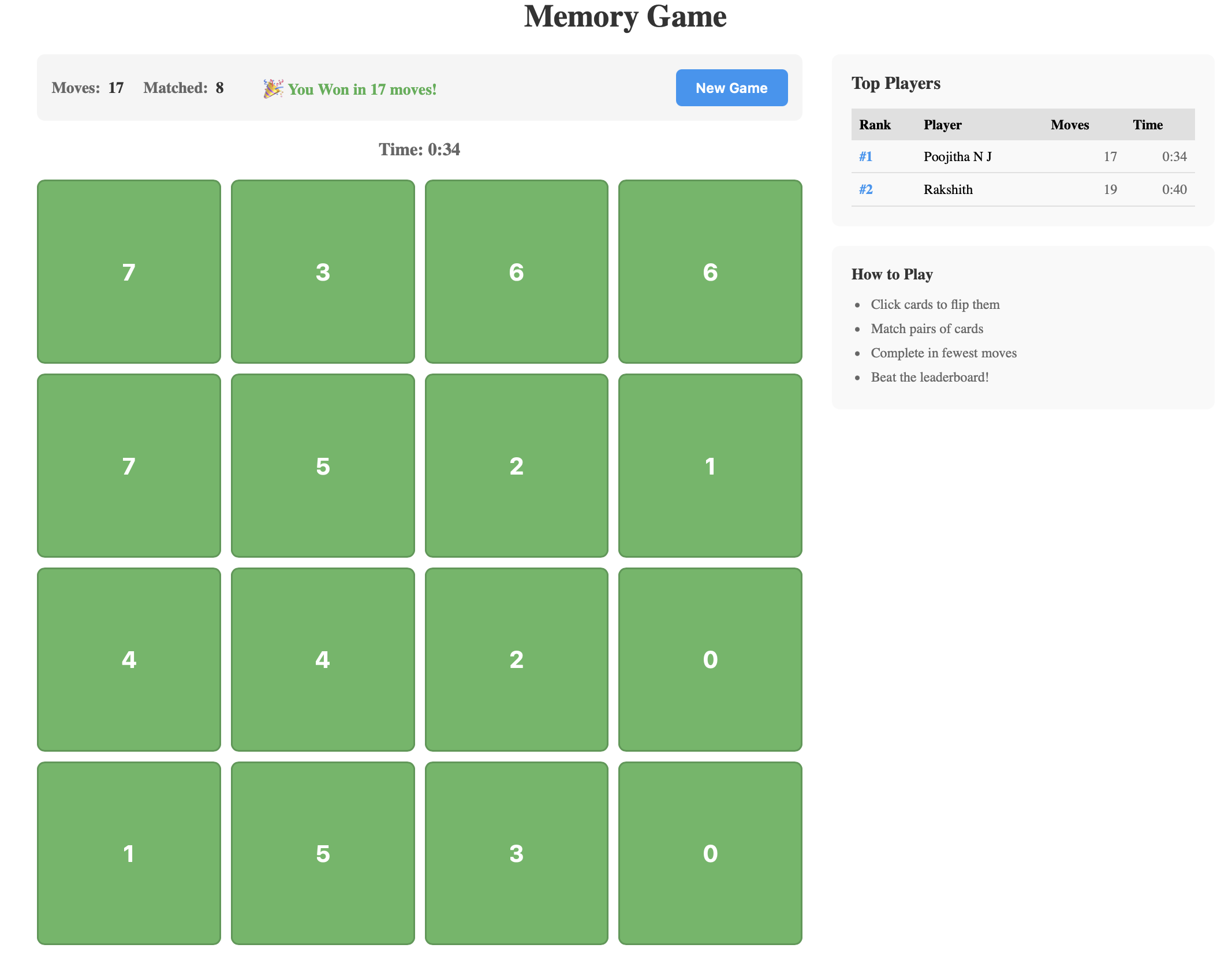
Sometimes the best coding projects don't come from big ideas… they come from the small, nostalgic ones.
This memory game started exactly like that.
I was thinking about what kind of project would be fun, simple, and still teach the fundamentals of web development. And suddenly I remembered something from childhood:
Those old picture-matching cards we used to play with.
Flip a card… flip another…
If they match, you win.
If not, flip back and try again.
Simple rules.
But surprisingly addictive.
And I thought — why not build this as a clean, tiny web project?
Turns out, this little game became one of the best beginner projects I've ever built.
🎯 Why a Memory Game?
Because it teaches the foundations of real-world development:
✔ DOM manipulation
Click → flip → compare → update UI.
This is the heart of frontend programming.
✔ State management
Which two cards are opened?
Are they a match?
Should they flip back?
A game is one of the best ways to learn handling "state".
✔ Logic building
The whole game runs on a simple but meaningful set of rules.
Perfect for beginners to sharpen logical thinking.
✔ UI / UX understanding
How should cards flip?
How fast should they animate?
What makes a game feel "fun"?
And the best part:
It looks simple, but you actually learn a LOT by building it.
🧠 How the Game Works (Simple Logic)
The memory game follows a very clear structure:
-
The board contains pairs of hidden cards
For example, 6 pairs → 12 cards. -
Player flips one card
-
Player flips second card
-
The game checks:
- If both cards match → keep them open
- If not → flip them back after a short delay
-
Repeat until all pairs are matched
-
Display:
- Moves taken
- Time spent
- Game over message
A complete game with just a few lines of logic.
🎮 What Makes It Fun?
Even though the rules are simple, the experience is surprisingly engaging because:
- You start recognizing patterns
- You try to remember positions
- You race against your own brain
- Matching pairs feels rewarding
- And flipping cards creates a mini dopamine hit 😄
It's a great game to build
and an even better game to play!
🔧 What You Learn By Building It
Building this game teaches you:
🟡 JavaScript basics
Variables, functions, loops, event listeners.
🟠 State management logic
Tracking opened cards, matched pairs, moves.
🔵 DOM updates & animations
Class toggling, CSS transitions.
🟣 Game flow structure
Start → play → win → restart.
Perfect for beginners and also a fun refresher for experienced developers.
📥 Download the Source Code
About Rakshith
Hi, I'm Rakshith — a tech educator, storyteller, and founder exploring the worlds of engineering, travel, wellness, and creativity. I believe learning doesn't stop at the classroom or the screen — it continues on highways, in temples, at beaches, and during quiet reflections. This space is my archive of experiences, experiments, and everything that makes life meaningful.
Enjoyed this article? Share it with others!
You Might Also Like

🎬 Coastal Karnataka Chronicles – Phase 2: The Cave, The Priest & The Night We Didn't Expect
Christmas morning at Udupi Sri Krishna Temple. Queue = 2 km. Waiting time = 4 hours. Did we wait? NO. We slid behind VIPs like CEOs of Udupi. Darshan done in 30 minutes. Skills > Tickets.

✨ Coastal Karnataka Chronicles – Phase 1: The Three Boys & The Butter Fish Revelation
Every December, the whole world prepares for Christmas… But three boys from Mysuru prepared for something more sacred — SEA FOOD. A religious pilgrimage to Prawn Mandir and Fish Devastana.
Energy-Efficient Optimization of Heterogeneous Wireless Sensor Networks Using a Two-Phase Genetic Algorithm
A detailed explanation of how a two-phase genetic algorithm improves sleep scheduling, routing, and clustering to extend the lifetime of heterogeneous wireless sensor networks. Includes research insights, graphs, and GitHub source code.
Comments
Leave a Comment
Loading comments...